
Disabling Mouse Acceleration
Long-Term Effects on Pointing Speed and Accuracy
Task battery reconstructions, replayed from real recorded trial data
Situation
For an HCI research methods course, our team of four wanted to test something with real anecdotal weight but no empirical backing: gamers swear by disabling mouse acceleration for "muscle memory" reasons, but nobody had actually tested whether that holds up over time, in real everyday use rather than a single lab session. The existing literature on control-display gain only measures performance at a single point in time, under a single setting; none of it looks at how people adapt once that mapping changes and stays changed. Motor learning theory gave us a reason to expect it would matter: stable sensorimotor mappings are what let movement become automatic, and acceleration's velocity-dependent gain keeps that mapping inconsistent by design.
Task
I was responsible for building the entire data-collection infrastructure: a SvelteKit web app that had to run unsupervised, remotely, on participants' own hardware, for 10 sessions across two weeks, with no lab session and no second chance if something silently broke mid-study. Alongside that, I later took on the statistical analysis, wrote the results section, and wrote the motor learning & muscle memory literature review.
Action
- Built the task battery (clicking, slider, dragging: 18 trials each, 54 per session) with difficulty levels grounded in Fitts' Law, e.g. clicking varied target radius (3/5/10mm) and distance (30/60/120mm) across all combinations
- Added a screen-calibration step matching an on-screen rectangle to a physical credit card, so task sizes stayed physically consistent regardless of each participant's actual screen
- Logged cursor position at 60Hz via requestAnimationFrame into PostgreSQL, with automatic screen-resolution detection and full session metadata per trial
- Stratified participants into control/experimental groups by baseline performance band (low/medium/high), not pure randomization, so both groups started from comparable skill levels
- Built an internal analytics dashboard to track participant compliance (session counts, missed sessions, automated reminder emails): dropout was the single biggest risk to a 2-week remote design, and it very nearly proved out: 25 participants started, 19 finished enough sessions to be included
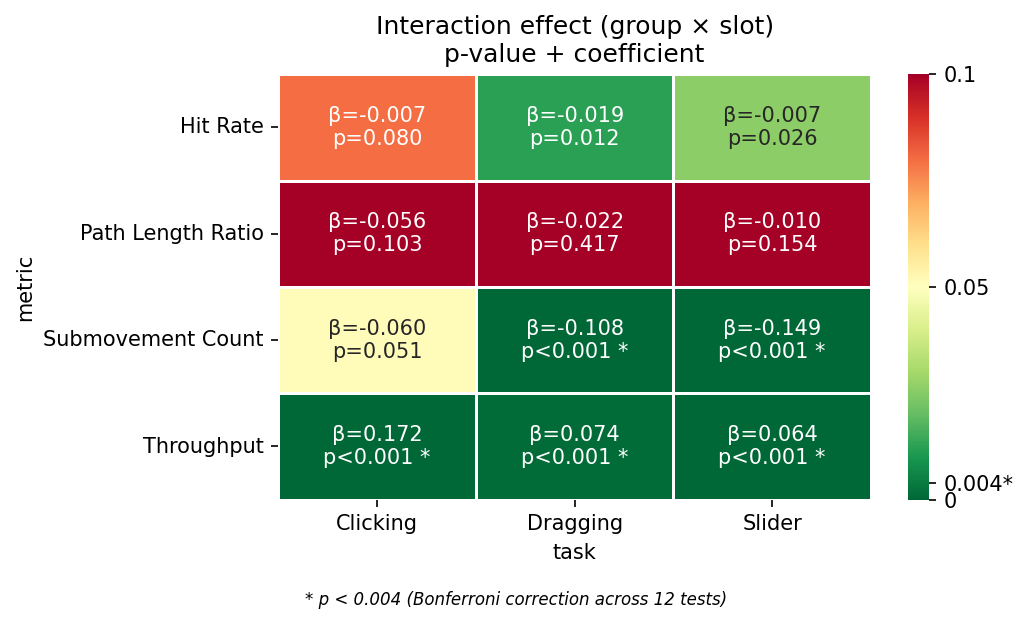
- Removed trial-level outliers with a MAD-based threshold (~1% of trials), then ran Linear Mixed-Effects Models (participant as random intercept, group × session as the effect of interest) across 12 tests with Bonferroni correction, in Python/statsmodels
- Wrote the results section and the motor-learning/muscle-memory literature review
Result
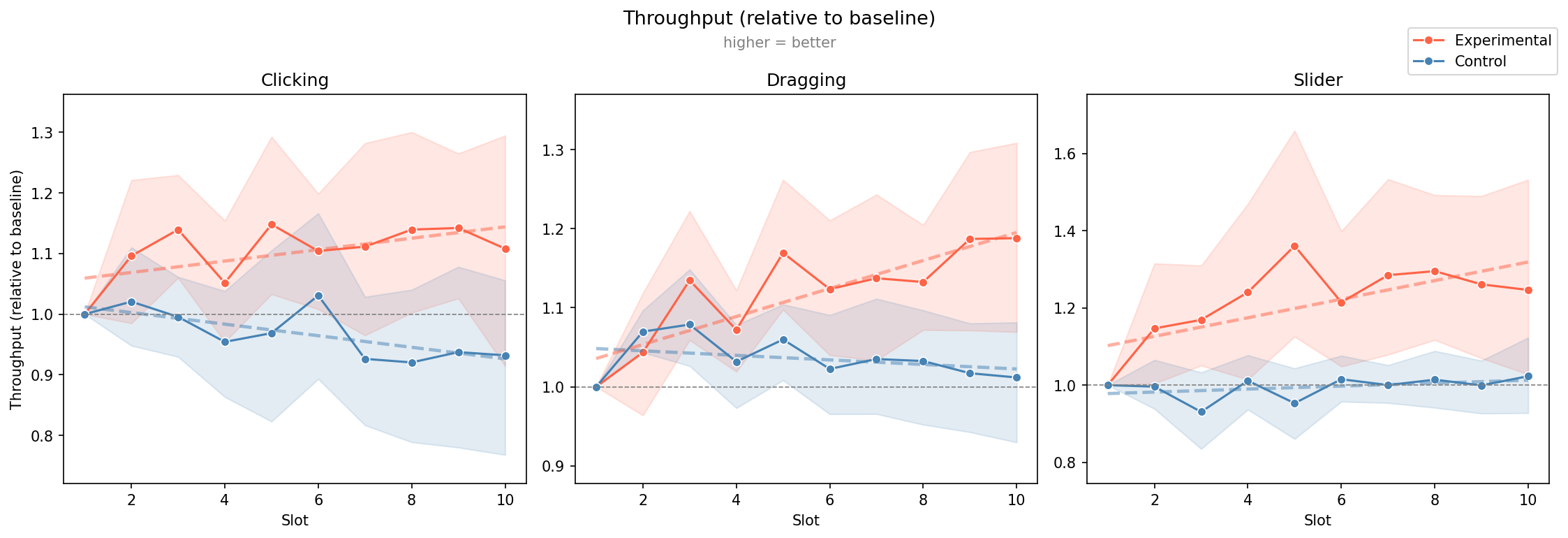
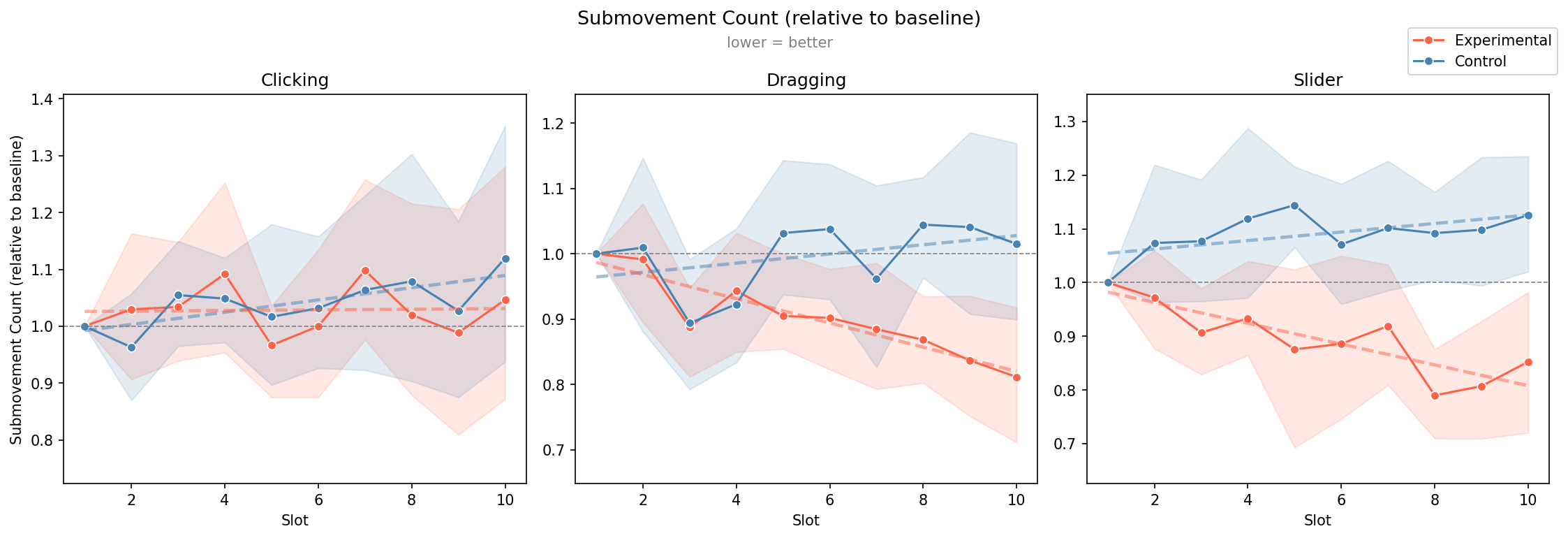
19 of 25 recruited participants completed enough sessions for inclusion (8 control, 11 experimental). The group × session interaction was significant for throughput across all three tasks (clicking: β=0.172, p<.001). The experimental group's throughput improved at a steeper rate every session than the control group's. Descriptively, that gap closed to +18.1% vs. −0.1% from baseline to the final session. Submovement count also dropped significantly faster for the experimental group on dragging and slider (both p<.001), meaning movements got smoother, not just faster. Clicking showed the same direction but didn't survive Bonferroni correction (p=.051). Path length ratio and hit rate showed no significant group differences; hit rate sat above 93% for everyone throughout, a ceiling that made it uninformative as a discriminating metric here. Effect sizes were small throughout (Cohen's f² ≤ 0.006): statistically real, practically modest.
Reflection
This project sits on the opposite end of the spectrum from PlantBand: instead of building a physical artifact people touch, I was building the instrument that measures, where a bug or a timing inconsistency could silently invalidate weeks of data. That responsibility shaped how I worked: defensive logging, a monitoring dashboard, daily participant check-ins instead of "set it and hope."
Running entirely on participants' own hardware, with no control over their mouse, screen, or environment, traded internal validity for ecological validity, and that trade-off is probably why our effect sizes stayed small despite being statistically significant: real variance from real, uncontrolled hardware doesn't disappear just because the model accounts for it. The null result on path length ratio was the most interesting one to sit with: it suggests the adaptation we measured was about speed and smoothness, not about moving in straighter lines, which is a more specific, more defensible claim than "disabling acceleration helps" would have been on its own. The statistics side (LMM with random intercepts, effect-size reporting, multiple-comparison correction) pushed my quantitative skills further than anything in my bachelor's.